

When you sit down to study, your instinct is probably to finish one topic before moving to the next. Slopes, then graphs, then expressions—nice and tidy. That approach is called blocked practice, and while it feels efficient, decades of research show it often leads to weaker long-term learning. The alternative—interleaving—mixes related topics in a single session and reliably improves test performance, even though it makes practice feel harder.
Blocked vs Interleaved: What's the Difference?
Blocked practice groups similar problems together: finish all the slope questions, then all the graph questions, then all the expression questions (AAABBBCCC).
Interleaved practice shuffles them: slope, graph, expression, slope, graph, expression (ABCABCABC).
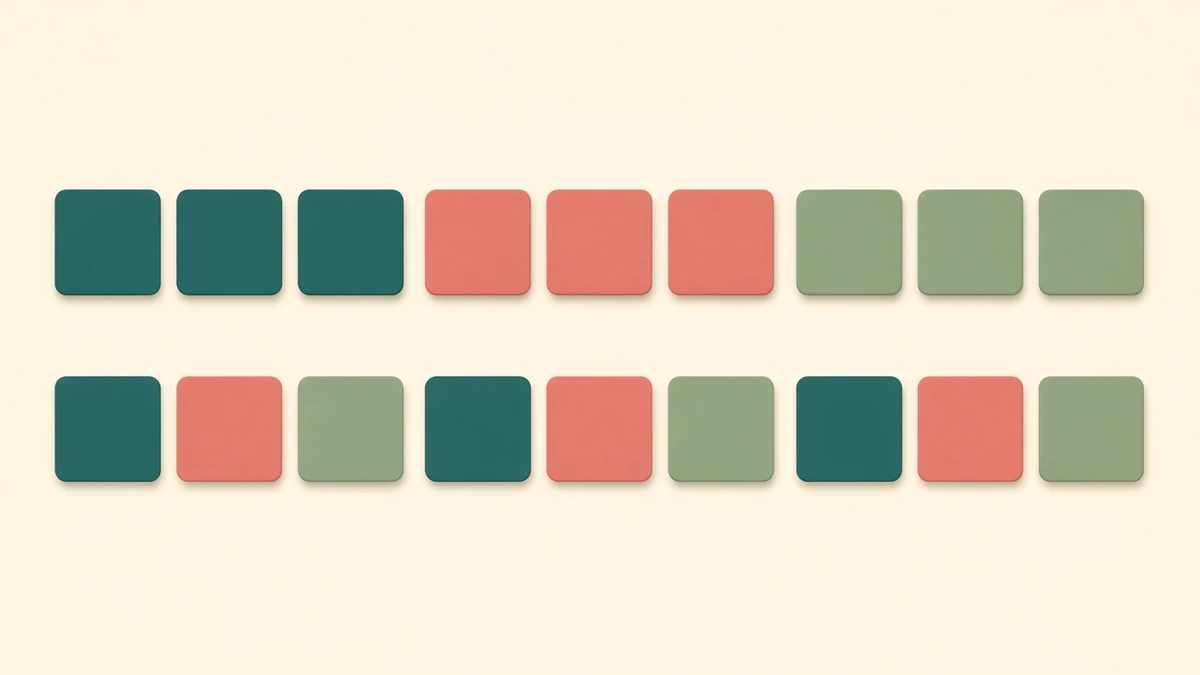
The difference matters because interleaving forces your brain to do two things at once: retrieve the right procedure and apply it. In a blocked drill, you already know which method to use—the challenge is only execution. On a real exam, you face both challenges together.
The Research: Why Mixing Works
Classroom Meta-Analysis (2026)
A 2026 meta-analysis by Ruitenburg and colleagues synthesized results from 53 studies with over 7,300 students in authentic primary and secondary classrooms (Ruitenburg et al., 2026). For interleaved practice specifically, the effect size was g = 0.40 (95% CI [0.10, 0.71])—large by educational-intervention standards. That estimate comes from 10 classroom studies and 57 effect sizes, so it is somewhat less precise than retrieval-practice estimates, but still robust.
Interestingly, the only significant moderator the authors found was feedback timing. With no feedback or delayed feedback, the interleaving effect remained strong (g = 0.25–0.82). With immediate item-by-item feedback, the effect was not significant. The authors suggest that instant corrections may reduce the need to discriminate between problem types—which is exactly the skill interleaving trains.
Laboratory and Mixed-Setting Meta-Analysis (2019)
Brunmair and Richter's earlier meta-analysis covered 59 studies, 238 effect sizes, and over 8,400 participants in labs and classrooms (Brunmair & Richter, 2019). The overall effect: g = 0.42. Effects were strongest for visual categories like paintings (g = 0.67) and still meaningful for mathematical tasks (g = 0.34). For words and expository texts, however, blocking sometimes won—interleaving is not a universal upgrade.
A Classic Experiment: Learning Artists' Styles
In Kornell and Bjork's 2008 study, participants learned to identify paintings by unfamiliar artists (Kornell & Bjork, 2008). When the learning phase interleaved artists, first-block test accuracy jumped to 61% versus 35% for blocked study (d ≈ 1.0). Yet 78% of participants said blocking felt as good or better than interleaving. The strategy that felt smoother was the weaker one for actual performance.
Interleaving in School Maths
A preregistered trial with 787 seventh-graders across 54 classes tested interleaved versus blocked homework over four months (Rohrer et al., 2020). One month after the final review, the interleaved group scored 61% on a surprise test; the blocked group scored 38% (d = 0.83). Every one of the 15 teachers saw a positive effect. Most teachers noted that students found the interleaved assignments slightly harder—but the payoff on the delayed test was substantial.
In a smaller earlier study, children who interleaved four types of maths problems scored 77% on a test one day later compared to 38% for the blocked group (d = 1.21), even though interleaving hurt their practice-session accuracy (Taylor & Rohrer, 2010).
Why Does Interleaving Feel Harder?

Interleaving is a desirable difficulty: it slows you down during practice but strengthens memory for later. The extra effort comes from:
- Discrimination practice — You must identify which method applies before you can execute it.
- Retrieval of multiple strategies — Each switch reactivates what you learned about the previous topic.
- Less fluent performance — Errors rise, which feels discouraging but signals deeper processing.
Fluency during a session is a poor predictor of durable learning. The Kornell and Bjork study is a perfect example: most participants preferred the schedule that produced worse test scores.
Practical How-To
- Start with a short blocked introduction. When a concept is brand-new, a few massed examples help you see the pattern before you mix. Then switch to interleaving.
- Mix related, confusable items. Interleave different maths problem types that might appear on the same exam, similar biology concepts, verb tenses you mix up, or artists' styles you want to distinguish. Avoid mixing unrelated subjects (maths and history) in one sitting—that is not what the research supports.
- Build quizzes as ABCABC, not AAABBBCCC. After a chapter on slopes, don't only drill slopes. Mix in graphs, expressions, and an older topic from last week.
- Finish a short mixed set before checking answers. The 2026 classroom meta-analysis suggests delayed or no feedback preserves the interleaving benefit better than immediate item-by-item feedback.
- Expect lower practice scores. If you're scoring worse during the session than you did in a blocked drill, that's normal—and often a sign the learning is sticking.
- Judge success on a later mixed test. The real payoff shows up days or weeks later. Don't abandon interleaving because today's drill felt rough.
- Budget a little extra time. Teachers in the Rohrer et al. (2020) trial reported that mixed assignments took slightly longer to complete.
Myths and Caveats
- Myth: "I should always feel like I'm improving during the session." Interleaving is a desirable difficulty. Practice scores often dip while later test scores rise.
- Myth: "Mixing anything helps." Interleaving works best for material you need to discriminate—especially when categories are similar. Brunmair and Richter found a blocking advantage for word lists (g = −0.39) and no reliable benefit for expository texts.
- Myth: "Skip blocking entirely." A short blocked warm-up on a brand-new topic is often helpful before you interleave.
- Myth: "Interleave whole subjects in one sitting." The literature typically means mixing related problem types, not jumping between unrelated courses.
- Caveat: Immediate feedback may reduce the effect. The 2026 classroom meta-analysis found no significant interleaving benefit when students got instant corrections—possibly because it removed the need to discriminate. Consider finishing a short set before revealing answers.
- Caveat: The interleaving classroom estimate (10 studies) is less precise than retrieval-practice estimates. Percentages vary; treat any single figure as illustrative, not absolute.
How StudyBounce Helps You Interleave
Building mixed practice sets by hand takes effort. StudyBounce handles the shuffling for you:
- Mixed flashcard decks — By default, cards are shuffled across related topics so you practise discrimination, not just execution.
- AI quizzes that mix topics — When you request a quiz on one chapter, items from recent related chapters are included, forcing you to pick the right approach.
- Exam-mode reviews — Cumulative mixed quizzes that mirror how exams actually look, not single-skill drills.
- "Mark then reveal" workflow — Complete a short mixed set and self-evaluate your answers before revealing solutions, aligned with the delayed-feedback findings.
- Desirable-difficulty nudges — The app reminds you that mixed practice may feel harder and produce more mistakes today—and that this is a feature, not a failure.
FAQ
What is interleaved practice?
Interleaved practice means mixing different problem types or topics within a single study session (ABCABC) instead of finishing all problems of one type before moving on (AAABBBCCC).
Does interleaving work for all subjects?
It works best when you need to tell similar categories apart—maths problem types, biological species, artists' styles, verb tenses. Evidence is weaker or mixed for word lists and expository texts.
Why does interleaving feel harder?
You must identify which method applies before executing it, which slows you down and increases errors. This extra effort strengthens long-term retention.
Should I give feedback immediately during interleaved practice?
Research suggests finishing a short mixed set before checking answers may preserve the benefit better than instant item-by-item feedback.
How much harder should practice feel?
Some increase in errors is expected—Taylor and Rohrer (2010) saw practice scores drop while test scores more than doubled. If you never make mistakes, you may not be challenging yourself enough.
The Takeaway
Mixing related topics during practice feels harder in the moment, but it pays off when it counts. Expect more mistakes while you practise, and treat them as a sign the method is working.
References
- Ruitenburg, S. K., Goos, M., Lambert, G., Kirschner, P. A., Jarodzka, H., & Camp, G. (2026). A meta-analysis of the effectiveness and boundary conditions of retrieval practice, distributed practice, and interleaved practice in authentic school classrooms. Educational Psychology Review. https://link.springer.com/article/10.1007/s10648-026-10225-5
- Brunmair, M., & Richter, T. (2019). Similarity matters: A meta-analysis of interleaved learning and its moderators. Psychological Bulletin, 145(11), 1029–1052. https://doi.org/10.1037/bul0000209
- Kornell, N., & Bjork, R. A. (2008). Learning concepts and categories: Is spacing the "enemy of induction"? Psychological Science, 19(6), 585–592. https://bjorklab.psych.ucla.edu/wp-content/uploads/sites/13/2016/07/Kornell_Bjork_2008_PsychScience.pdf
- Taylor, K., & Rohrer, D. (2010). The effects of interleaved practice. Applied Cognitive Psychology, 24, 837–848. https://onlinelibrary.wiley.com/doi/10.1002/acp.1598
- Rohrer, D., Dedrick, R. F., Hartwig, M. K., & Cheung, C.-N. (2020). A randomized controlled trial of interleaved mathematics practice. Journal of Educational Psychology, 112(1), 40–52. https://doi.org/10.1037/edu0000367
- Pan, S. C. (2015, August 4). The interleaving effect: Mixing it up boosts learning. Scientific American. https://www.scientificamerican.com/article/the-interleaving-effect-mixing-it-up-boosts-learning/