
Rereading a chapter feels like studying. The lines look familiar, and the next day the page is gone. The pretesting effect flips that order. You test yourself before you study, on ideas you have not learned yet, and you get most of the questions wrong. That miss shows the gap, and the reading that follows lands on the ideas you asked about. For how to study effectively, and how to remember what you study once the session is over, start with a few questions. Then lock the answers in with spaced retrieval, not another pass through the same notes.
What is the pretesting effect?
The pretesting effect is the gain from attempting problems before instruction. A 2026 conference paper defines it in one line: pretesting "supports learning by activating prior knowledge and sharpening attention to subsequent instruction" (Akgun & Toker, 2026). Reviews call these items prequestions, and they group the method with errorful generation and unsuccessful testing. Try, miss, then study the correct answer (Pan & Carpenter, 2023).
Richland, Kornell, and Kao ran five experiments with an essay about vision. One group answered questions before reading. Controls received extra reading time, with the tested ideas emphasised in italics or bold. In the fifth experiment the control group saw the questions and did not answer them. The pretest group did better in all five experiments, counting only items people had missed on the pretest (Richland, Kornell & Kao, 2009). Pan and Carpenter time that design at two minutes on five questions plus eight minutes of reading, against ten minutes of reading. Pretest takers typically got three-quarters or more wrong. The benefit appeared immediately in the first three experiments and a week later in the fourth. Minutes were matched, so the questions replaced reading time and still won.
Does getting answers wrong help you learn?
Yes, when the correct answer follows. Kornell, Hays, and Bjork used fictional trivia, including "What peace treaty ended the Calumet War?", and weak pairs such as whale and mammal. Guesses were essentially always wrong, and correct guesses were excluded. Trying first, then seeing the answer, beat reading the question and the answer together: "taking challenging tests-instead of avoiding errors-may be one key to effective learning" (Kornell, Hays & Bjork, 2009).
The vision experiments analysed only those misses and still found a benefit, so a wrong guess does not stick once you study the correction. The University of Chicago Learning Lab puts it plainly: "failure to answer test questions correctly shouldn't be equated with failure to learn … as long as they are followed by related instruction or feedback" (UChicago Learning Lab).
Akgun and Toker note that these benefits often occur even when the first response is incorrect, and they cite work in which answering before a lookup beat looking the answer up immediately. It feels like a waste. Learners have ranked pretesting least effective in studies where it helped the most (Huelser & Metcalfe, 2012, via Pan and Carpenter). Leave it ungraded.
How big is the pretesting effect, and what does it not do?
A pretest does not cover the chapter. In a preregistered meta-analysis the specific effect, on material you were asked about, was g = 0.54 across 97 effect sizes. The general effect, on other material in the same lesson, was g = 0.04 across 91 effect sizes, which the authors call virtually nonexistent (St. Hilaire, Chan & Ahn, 2024).
Pan and Carpenter find the same split. Directly tested information benefits consistently. Untested information in the same text is highly inconsistent: only one of five Richland experiments found a spillover. Short answer, fill-in-the-blank, and multiple choice all work, and plausible wrong options can also help related facts you were not asked (Little & Bjork, 2016, via the review). Word pairs needed the answer immediately. Trivia and texts still worked with an answer up to 24 hours later (Kornell, 2014, via the review). Effects lasted at least a day and, for text, at least seven days; after 24 hours or more, reported d ran from 0.44 to well over 2.0, largest at one week in one series (Kliegl and colleagues, 2022, via the review).
Classroom gains are smaller. Pan and Carpenter summarise about an 8 to 9 percent final-exam advantage in a 10-week course that gave a brief multiple-choice pretest, with no feedback, before some lectures only. Learning improved for pretested items and for related items that were not pretested, many students used the pretests to guide their study, and the lecturer never saw the questions (Soderstrom & Bjork, 2023). The review also notes unit tests 9 to 12 percent higher (Beckman, 2008), about 7 percent better at the end of a lecture but not a week later (Carpenter and colleagues, 2018), and a MOOC with no overall benefit where pretested students were more likely to drop out, though completers did better (Janelli & Lipnevich, 2021). Keep it to a few ungraded questions.
Concrete claims the text states directly are the better target. Complex inference questions tend not to benefit (Hausman & Rhodes, 2018, via the review), and with no hook into the topic the guess has little to catch on.
How to test yourself before you study (5 steps)
Two to five minutes, before the notes open.
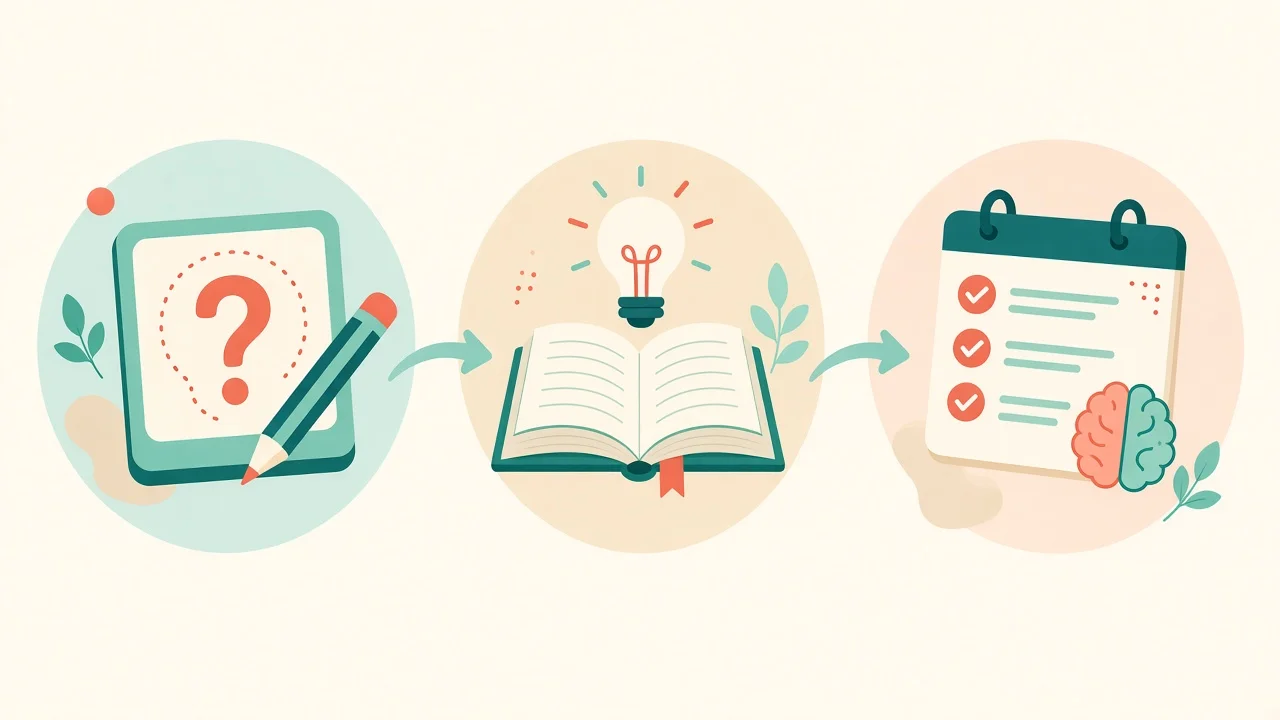
Turn headings into practice questions
Should you take a practice test before studying? Yes, a short one, aimed at what the real test will ask. Turn the headings, the learning objectives, last year's paper, or the end-of-chapter questions into three to six questions. Richland used five. The review describes another study that used six before a video of about seven minutes. How to study with practice questions, here, means writing them while you still cannot answer. "What does the axon terminal release?" is that kind of item. An inference question such as "Explain how synaptic plasticity supports learning" is the kind this research finds less helpful. Plausible multiple-choice options are a fair format.
- Write three to six questions on the ideas you cannot afford to miss, before you open the notes.
- Answer in writing, and guess if you must. Mark the guesses. Attempting beat merely seeing the questions in Richland's fifth experiment.
- Study with the questions in view. Read or watch while you look for the line that settles each one.
- Correct every attempt in your own words before you close the book. The effect depends on meeting the right answer afterwards.
- Keep the stakes at zero. Wrong answers are the method, and the method feels unproductive while it works.
Then lock it in: spaced retrieval, not rereading
Is rereading notes effective? Feeling ready is not the same as remembering. A week later, testing beat restudy, 56 percent to 42 percent, and restudy left people more confident (Roediger & Karpicke, 2006). That is rereading versus retrieval practice.
Later the same day, answer the original questions from memory. A few days later, answer them again and add questions for ideas the first list missed. Producing the answer is active recall, the gap is spaced repetition, and the new questions matter because unasked material barely benefits. When you next have to tell similar problems apart, mixing them in one session trains that choice.
Akgun and Toker (2026) are useful for this follow-up, not as proof the pretest worked. All 89 undergraduates, in one applied-statistics course on multiple linear regression, attempted questions before any explanation. Direct solutions were withheld to preserve productive struggle, and the AI asked for elaboration when an answer was superficial. After the same lesson and a baseline test, the next seven weeks were adaptive spaced retrieval (n = 27), a fixed retrieval list (n = 28), or free use of the same AI (n = 34) (Akgun & Toker, 2026).
Nobody skipped the pretest. The authors write that "adaptive pretesting can elevate initial understanding, but sustained learning depends on how subsequent AI-supported practice is structured." Treat "elevate initial understanding" as their interpretation, not a measured contrast. The report is a conference preprint: one course, small groups, effort scored by raters, and no group without AI. They call pretesting a front-loaded catalyst and write: "When followed only by learner-directed AI interaction, however, its benefits may attenuate." Adaptive spaced retrieval came out ahead of free-form study. The fixed list did not clearly do so, and the two retrieval formats were not clearly different. Retrieval groups also put in more effort. The scores sit in how to use AI to study. An earlier abstract, with no figures used here, says struggling first was "most pronounced in complex, exploratory tasks rather than straightforward computational problems" (Akgun & Toker, 2025).
Pretesting vs retrieval practice: which is better?
Use both, with the pretest first. It is the warm-up, not the stronger test.
Latimier and colleagues compared them with biology texts, 285 analysed participants, and a test seven days later. Against extra reading, post-testing reached d = 0.74 and pretesting d = 0.35, about twice the effect. Only post-testing transferred to questions students had not trained on. Pretesting's transfer effect was d = −0.01 (Latimier et al., 2019). de Lima and Jaeger (2020) also favoured testing after study. Pan and Sana (2021) favoured pretesting, with effect sizes of 0.30 and 0.14. One low-dose prequestion added nothing on top of retrieval practice (Geller, 2017; Carpenter and colleagues, 2018; via Pan and Carpenter). Attempt, study, then retrieve again on a delay.
FAQ
What is the pretesting effect?
It is the gain from trying questions before you study, wrong answers included, provided you then see the correct answer. Prequestions, pretests, and errorful generation name that same order.
Does getting answers wrong help you learn?
It can. Studies that kept only the failed attempts still found better recall once the right answer followed. You remember the correction, not the guess.
Should I take a practice test before studying?
Yes. Three to six questions on the key ideas, in two to five minutes, from the headings or an old paper. Study with them in view and correct every attempt.
Is pretesting better than retrieval practice?
Not as a substitute. After seven days, testing after study (d = 0.74) beat testing before it (d = 0.35), and only the later test helped on new questions. Do the early questions, then retrieve the answers after you study.
How many questions should I try before studying?
Three to six, on ideas you need. Five were enough for the vision essay. The benefit stays with the questions you attempt, so revisit that short list instead of writing a long quiz you drop.
Is rereading notes effective?
It feels effective. A week later, testing beat restudy, 56 percent to 42 percent, and restudy had raised confidence. Reread to check an answer you have already tried to give.
Related posts
- How to Use AI to Study: Let It Quiz You covers the same 2026 paper from the quizzing side: what happened when the AI kept asking after the pretest, instead of chatting on demand.
- Mix Your Practice, Don't Block It: The Science of Interleaving is the next skill, once you can retrieve an idea and an exam makes you choose which idea a question needs.
Try the questions before the summary
The pretesting effect is a change in order. Try the questions before you open the notes, write the right answer beside every guess, then answer those questions again from memory on a later day and add new ones for anything you were never asked. StudyBounce follows that order on your own chapter: you can quiz yourself before you read the summary, and the misses come back as spaced reviews instead of another reread. When the next test is close, create your free account and try it on your next chapter.
References
- Akgun, M., & Toker, S. (2026). Do gains from generative AI–enabled adaptive pretesting persist? Evidence from a retention study. arXiv:2606.22328. 27th International Conference on AI in Education. https://arxiv.org/abs/2606.22328
- Akgun, M., & Toker, S. (2025). Struggle First, Prompt Later. arXiv:2504.10249. https://arxiv.org/abs/2504.10249
- Kornell, Hays, & Bjork (2009). Unsuccessful retrieval attempts enhance subsequent learning. Journal of Experimental Psychology: Learning, Memory, and Cognition, 35(4), 989–998. https://pubmed.ncbi.nlm.nih.gov/19586265/
- Latimier et al. (2019). Does pre-testing promote better retention than post-testing? npj Science of Learning, 4, 15. https://www.nature.com/articles/s41539-019-0053-1
- Pan & Carpenter (2023). Prequestioning and pretesting effects: A review of empirical research, theoretical perspectives, and implications for educational practice. Educational Psychology Review, 35, article 97. https://link.springer.com/article/10.1007/s10648-023-09814-5
- Richland, Kornell, & Kao (2009). The pretesting effect: Do unsuccessful retrieval attempts enhance learning? Journal of Experimental Psychology: Applied, 15(3), 243–257. https://pubmed.ncbi.nlm.nih.gov/19751074/
- Roediger, H. L., III, & Karpicke, J. D. (2006). Test-enhanced learning: Taking memory tests improves long-term retention. Psychological Science, 17(3), 249–255. https://pubmed.ncbi.nlm.nih.gov/16507066/
- Soderstrom & Bjork (2023). Pretesting enhances learning in the classroom. Educational Psychology Review, 35. https://link.springer.com/article/10.1007/s10648-023-09805-6
- St. Hilaire, Chan, & Ahn (2024). Guessing as a learning intervention: A meta-analytic review of the prequestion effect. Psychonomic Bulletin & Review, 31(2), 411–441. https://doi.org/10.3758/s13423-023-02353-8
- University of Chicago Learning Lab. The pre-testing effect. https://learninglab.uchicago.edu/Pre-Testing.html