How to use AI to study is a question of who does the remembering. A tidy chatbot explanation feels like progress, and a 2026 conference study says that feeling misleads. Students quizzed adaptively by the same AI scored about 11 points higher at semester's end than classmates who used it as an answer machine. The difference is active recall: you produce the answer, and the model speaks only after you have tried.
Three ways of using the same AI
Mahir Akgun and Sacip Toker followed 89 undergraduates through multiple linear regression at a US public university (Akgun & Toker, 2026). The report is a short conference paper, an arXiv preprint for the 27th International Conference on AI in Education: one classroom, not a journal verdict.
Everyone first took an adaptive AI pretest that withheld solutions, then the same lesson and a baseline test. Trying questions before the lesson is pretesting, a separate technique. Over the next seven weeks the same AI was used in one of three ways:
- Adaptive spaced retrieval (n = 27). New questions and the feedback depended on earlier answers.
- Fixed spaced retrieval (n = 28). A fixed list, one question at a time, no feedback, no adaptation.
- Learner-directed study (n = 34). Students asked anything and read the reply.
That last arm is ordinary how to use ChatGPT to study. All three groups had three scheduled sessions, and chat length did not differ significantly.
Adaptive quizzing beat free chatbot study
The end-of-semester test was 14 scenario-based items, scored 0–100, parallel to the baseline. Adjusted means were 78.19 (adaptive), 74.55 (fixed), and 67.28 (free chat). Adaptive versus free chat was about 11 points, d = 0.92, p = .003 (F(2, 85) = 6.24, partial η² = .128). The authors write that "learning outcomes depend on whether AI access is structured to elicit retrieval rather than enable passive review."
Fixed quizzing was not significantly different from free chat after adjustment (d = 0.57, p = .071) or from adaptive quizzing (p = .830). Only adaptive quizzing clearly beat open chatbot study.
Effort, scored 0–1 from the logs, averaged 0.85, 0.74, and 0.49. Both quiz formats drew significantly more engaged effort than free chat; adaptive and fixed did not differ (p = .493). Variances were unequal, so read the effort result with caution.
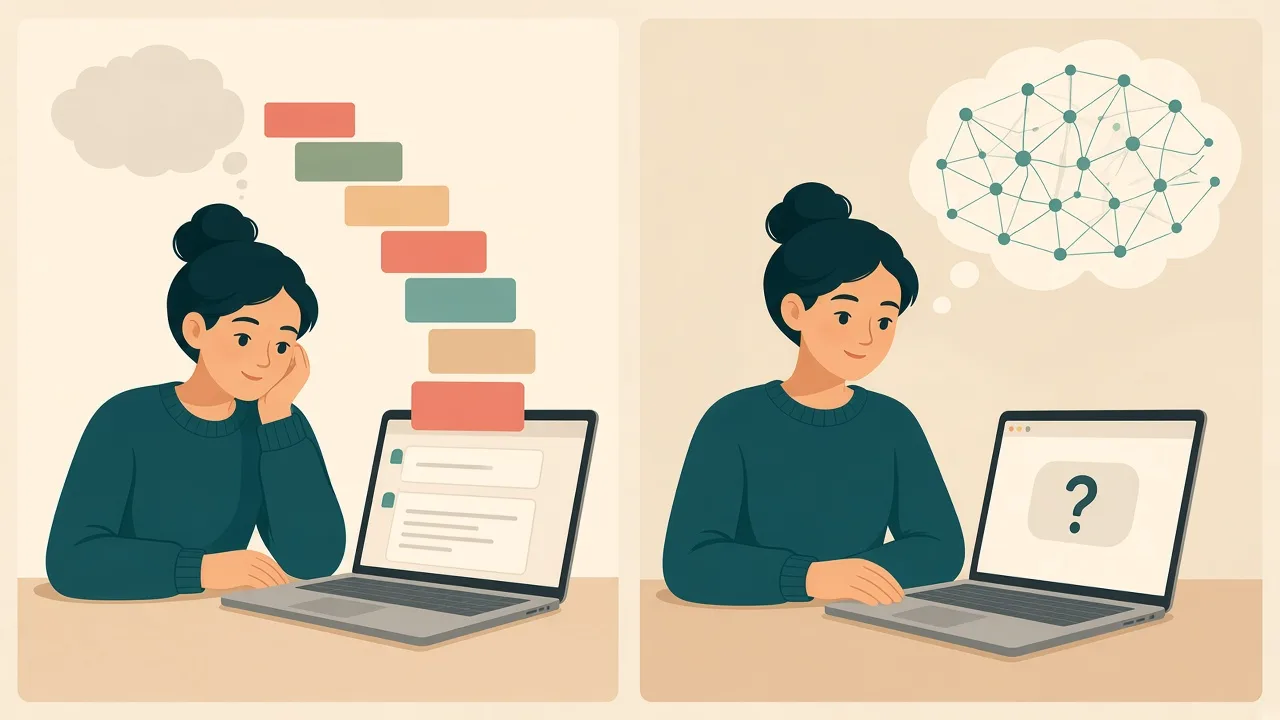
One course, groups of about 30, and no group studying without AI. This does not show that an AI quiz beats a paper quiz. It shows that adaptive quizzing beat free use of the same model.
Is using AI to study bad? Only when it answers for you
In a large Turkish high school, nearly 1,000 students in grades 9 to 11, across about fifty classes, had four 90-minute sessions (Bastani et al., 2025). Practice grades rose 48% with an unrestricted ChatGPT-style tutor and 127% with a hint-only tutor. On a later exam without AI, the unrestricted group scored 17% worse than a no-AI control. Hints removed that harm and did not beat studying with no AI. Students used the open bot as a "crutch", "asking for and copying solutions", and did not notice. Hint-only students believed they had done significantly better. They had not.
The other design can teach in the short run. In Harvard introductory physics (N = 194), median post-tests were 4.5 with an AI tutor and 3.5 with in-class active learning, and the median learning gain more than doubled (p < 10⁻⁸; Kestin et al., 2025). The authors call it short-term, warn against AI used "as a crutch to circumvent critical thinking", and leave spacing for later work. Generative AI "can boost learners' performance" without "the deep cognitive and metacognitive processing that are required for high-quality learning" (Yan et al., 2025).
How to use AI for active recall
Restudy beat a no-feedback memory test after five minutes, 81% to 75%. Testing led after two days, 68% to 54% (d = 0.95), and after a week, 56% to 42% (d = 0.83; Roediger & Karpicke, 2006). A week later in a second experiment, repeated testing, one test, and repeated study scored 61%, 56%, and 40%. Restudy also raised confidence: the fluent reread felt safer than the test that lasted.
Active recall is that habit on your own notes. An AI explanation is restudy. Trying a task before searching beat searching first on a later transfer test (means .56 versus .50, d = 0.31; Giebl et al., 2021). Use the same order when the search bar is a chatbot.
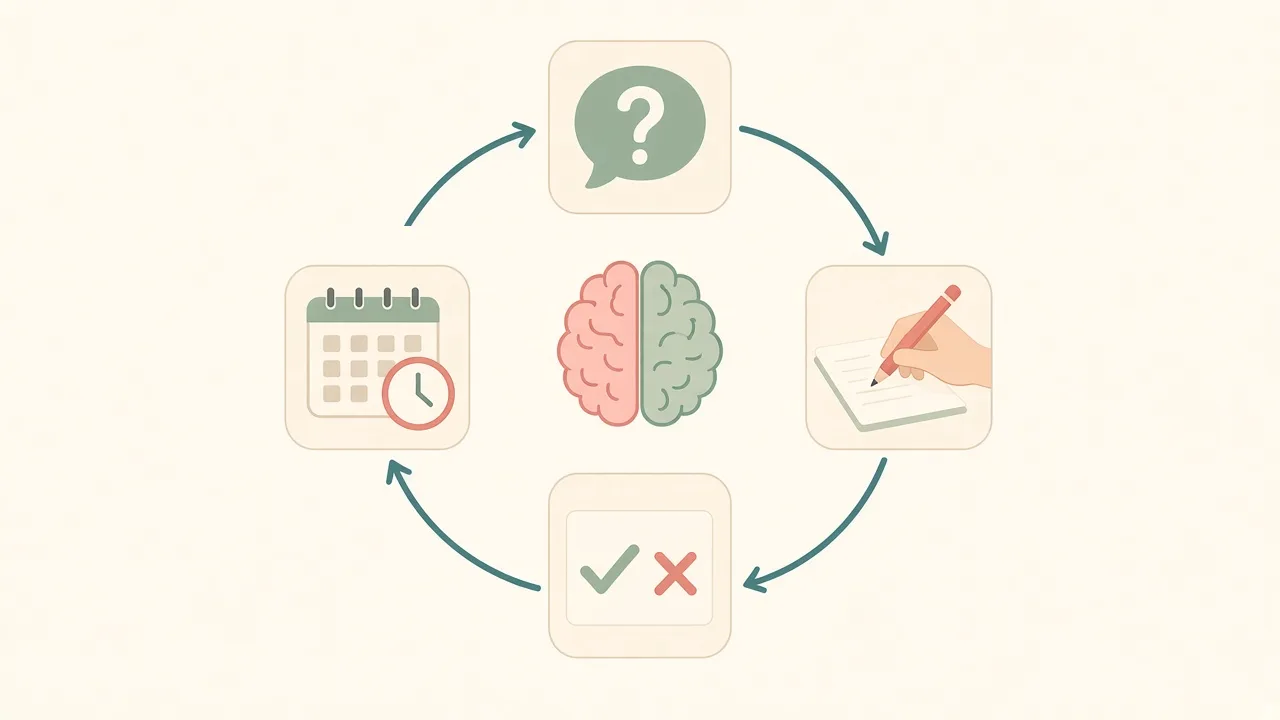
One question, your answer from memory, feedback that quotes your notes, then the miss again on a later day. That last beat is spaced repetition. Spacing cannot explain the 11-point gap: all three groups already had three sessions over seven weeks. The condition that beat free chat adapted the next question and gave feedback, and even that was not significantly ahead of the fixed list. Spread the reviews anyway. Testing beats restudy after days, not after five minutes.
How to get ChatGPT to quiz you (copy-paste prompts)
Paste this, then your notes. It is a ChatGPT quiz prompt if that is the window you have open. The rules are the method.
The quiz-me prompt
You are my retrieval-practice partner. I will paste notes below.

Rules:
- Quiz me one question at a time, and wait for my answer.
- Do not show the answer, a hint, or the next question until I reply.
- Then say if I was right, quote the line in my notes, and explain only if I missed it.
- If I ask for help first, give one hint, not the solution.
- Track misses. Later questions return to them and go one step deeper.
- After 8 questions, stop, list misses and hits, and wait.

Notes:
Eight is a practical cap, not a result from the study.
Let the AI quiz you on your notes
People type "AI quiz me on my notes". Paste one sitting's worth and let it ask you to state the idea, not to request "explain the chapter". You answer. It quotes the note. If an answer key appears, reply: "Stop. One question. Wait."
Ask for a hint, not the answer
I'm stuck. One hint pointing at the idea in my notes. Do not state the answer, the formula, or the final number. Then wait.
Withholding the solution removed the exam harm in the high-school trial. It did not raise scores above the no-AI group.
Space the sessions
From what I missed or hesitated on, plan reviews for tomorrow, a few days later, and next week. One question at a time. Wait for me. Start tomorrow only if I say "start".
Three sittings follow the study's shape. The gaps are a calendar you can keep, not a measured optimum. If a mark surprises you, ask for the quoted line and check the source. Models reject right answers and invent sentences; the Harvard prompts included worked solutions for that reason. Your notes win ties.
Mistakes that turn a study partner into an answer key
- Reading the explanation and calling it revision. A week later, testing remembered 56% and restudy 42%.
- Trusting the smooth feeling. Open-bot users did not notice they had learned less.
- A list that never adapts. Fixed quizzing was not significantly ahead of free chat (p = .071).
- One sitting, or letting the bot write the work. Testing beats rereading after a delay. Copying a solution you never tried is the crutch.
How StudyBounce runs the loop
The prompts work in any chatbot if you restate the rules and come back. StudyBounce starts from the materials: notes and slides become quizzes and flashcards, the first move is answering from memory, and harder items return sooner. When the next skill is choosing which idea a question needs, mixing related problem types trains that choice.
FAQ
Is using AI to study bad?
It can be, when the model answers for you. Unrestricted help preceded a 17% lower exam score. Adaptive quizzing beat free chatbot study by about 11 points; fixed quizzing fell in between and was not significant (p = .071).
Does ChatGPT help you learn?
It can, if you retrieve. The same agent lined up with higher end-of-semester scores when questions adapted to misses, and explaining on demand resembles restudy, which lost to testing after a few days.
How do I get ChatGPT to quiz me?
Paste the quiz-me prompt, then the notes. One question at a time, and it waits. Restate the rule if it answers early.
How do I stop ChatGPT showing the answer straight away?
Forbid the answer, the hint, and the next question until you reply. If you are stuck, ask for one hint.
How many questions should I do in one session?
The study set the sessions, not a magic count: three over seven weeks. Eight is only a cap so you still answer from memory. Aim the next session at misses.
Can the AI grade my answers incorrectly?
Yes. It can reject a right answer or cite a line you never wrote. Ask for the quote from your notes, and check it.
Related posts
- Mix Your Practice, Don't Block It: The Science of Interleaving — Once you can retrieve an idea, mixing related problems trains you to pick a method, which is what exams ask.
- AI Flashcards from PDFs, PowerPoint, Audio & YouTube in Seconds — Notes become flashcards you answer from memory, then meet again on a spaced schedule.
Make the next session a quiz
How to use AI to study, if you want the learning to last, means letting the model ask and answering before you read. StudyBounce makes that the default on your own material: notes become a quiz, misses come back through spaced review, and the session is retrieval instead of another summary. Create your free account and run one set of notes as a short quiz before you open them again.
References
- Akgun, M., & Toker, S. (2026). Do gains from generative AI–enabled adaptive pretesting persist? Evidence from a retention study. arXiv:2606.22328. 27th International Conference on AI in Education. https://arxiv.org/abs/2606.22328
- Bastani et al. (2025). Generative AI without guardrails can harm learning: Evidence from high school mathematics. Proceedings of the National Academy of Sciences, 122(26), e2422633122. https://pmc.ncbi.nlm.nih.gov/articles/PMC12232635/
- Kestin et al. (2025). AI tutoring outperforms in-class active learning. Scientific Reports, 15, 17458. https://www.nature.com/articles/s41598-025-97652-6
- Roediger, H. L., III, & Karpicke, J. D. (2006). Test-enhanced learning: Taking memory tests improves long-term retention. Psychological Science, 17(3), 249–255. https://pubmed.ncbi.nlm.nih.gov/16507066/
- Giebl, S., Mena, S., Storm, B. C., Bjork, E. L., & Bjork, R. A. (2021). Answer first or Google first? Psychology Learning & Teaching, 20(1), 58–75. https://journals.sagepub.com/doi/full/10.1177/1475725720961593
- Yan, L., Greiff, S., Lodge, J. M., & Gašević, D. (2025). Distinguishing performance gains from learning when using generative AI. Nature Reviews Psychology, 4, 435–436. https://www.nature.com/articles/s44159-025-00467-5